01
Profile
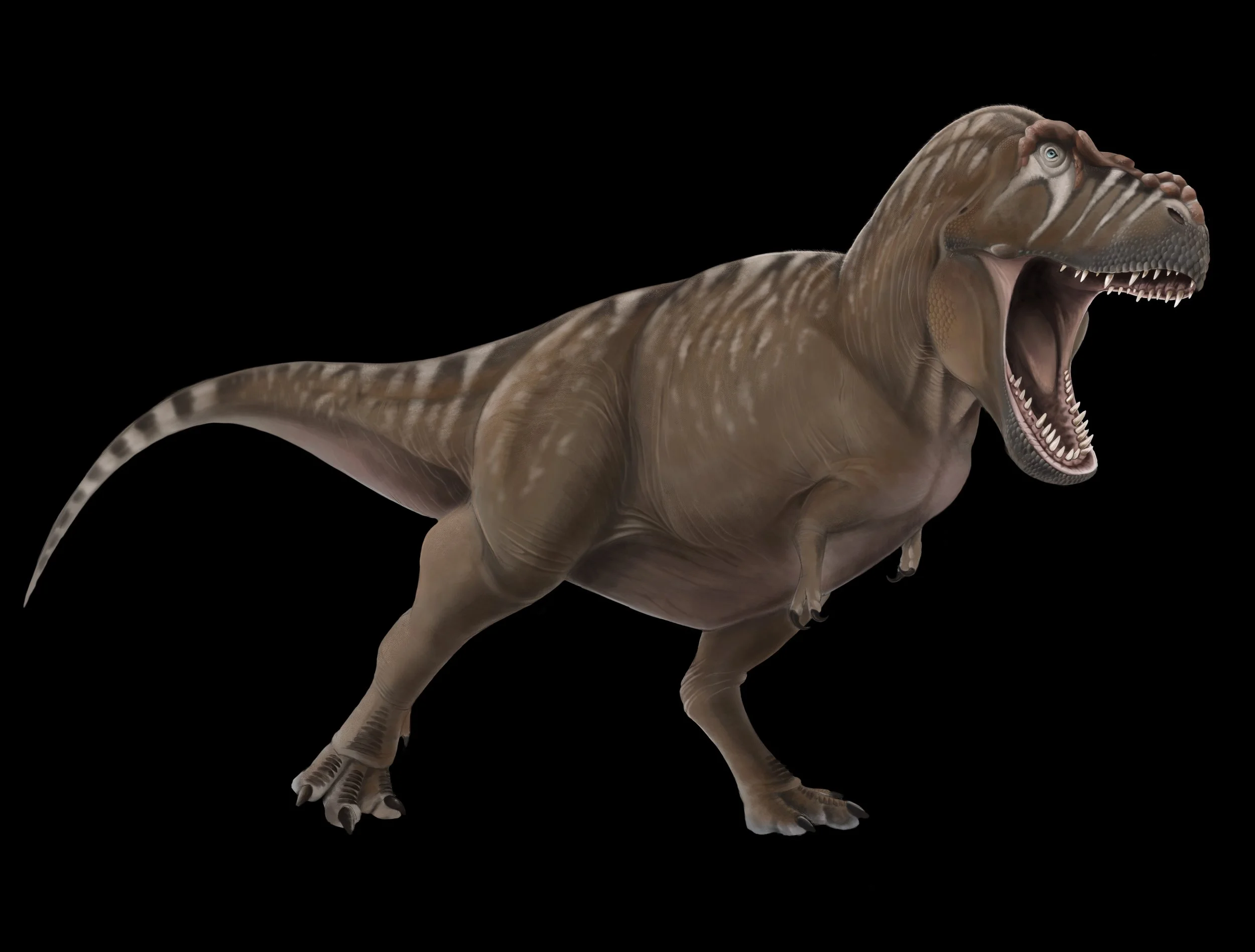
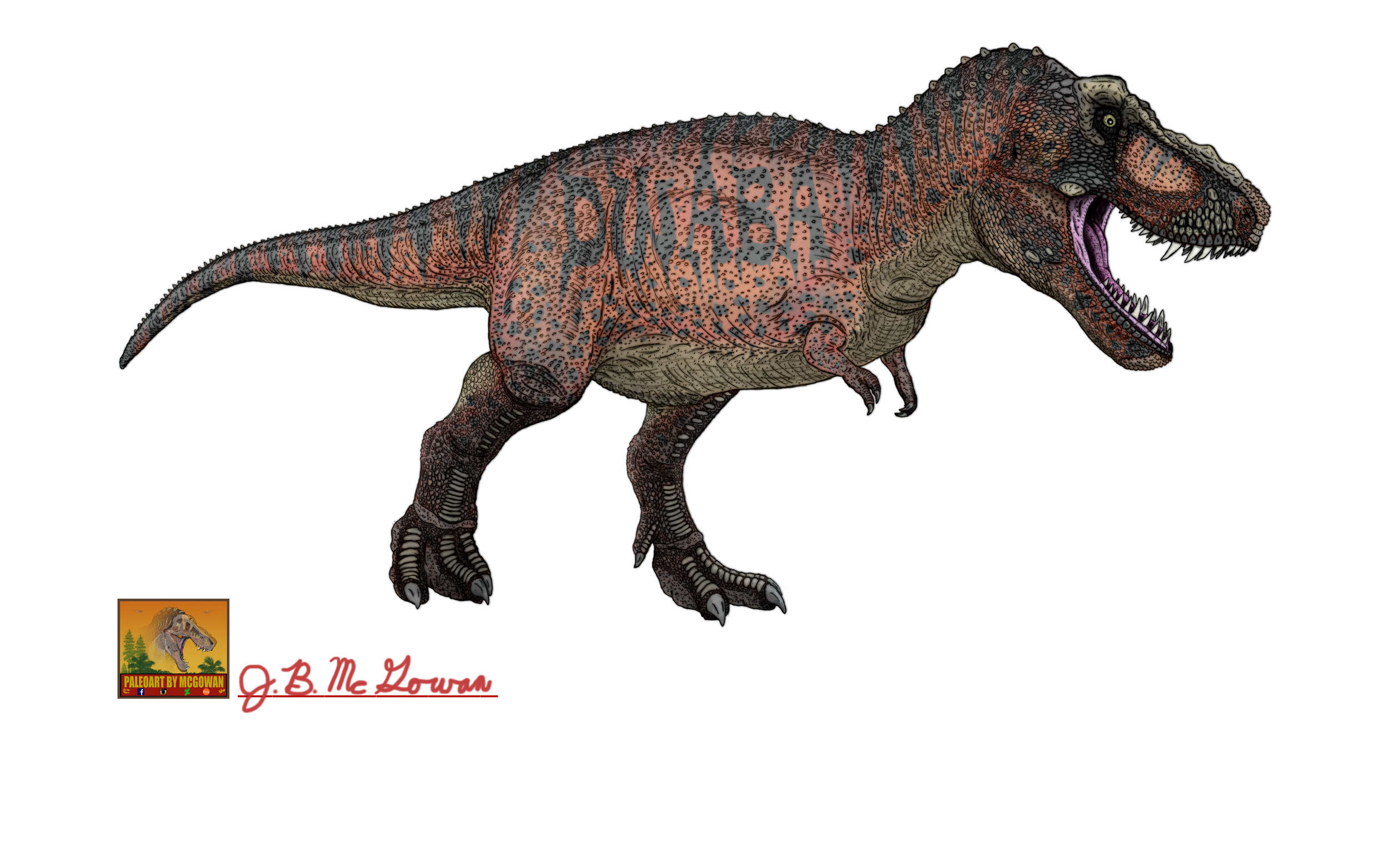
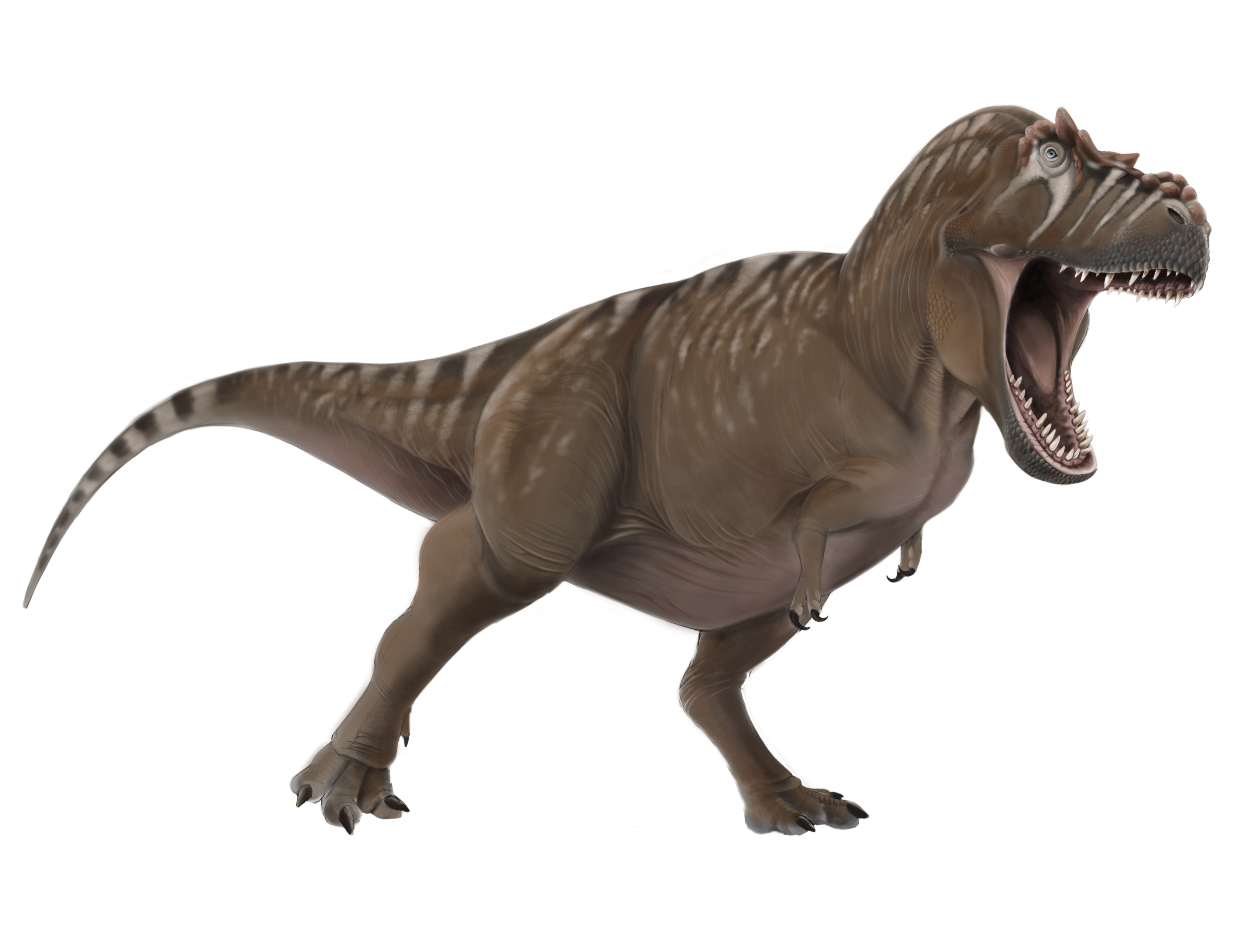
Let's be honest: you already know who this is. Tyrannosaurus rex is the undisputed celebrity of the dinosaur world — the one whose name every four-year-old can pronounce before they can tie their shoes. And yet, somehow, the real animal is even more impressive than the franchise. It lived 69 to 66 million years ago across what is now the American West — a place called Laramidia, an ancient island continent that makes Florida look positively young — and it was among the very last non-avian dinosaurs standing before an asteroid rudely ended the party.
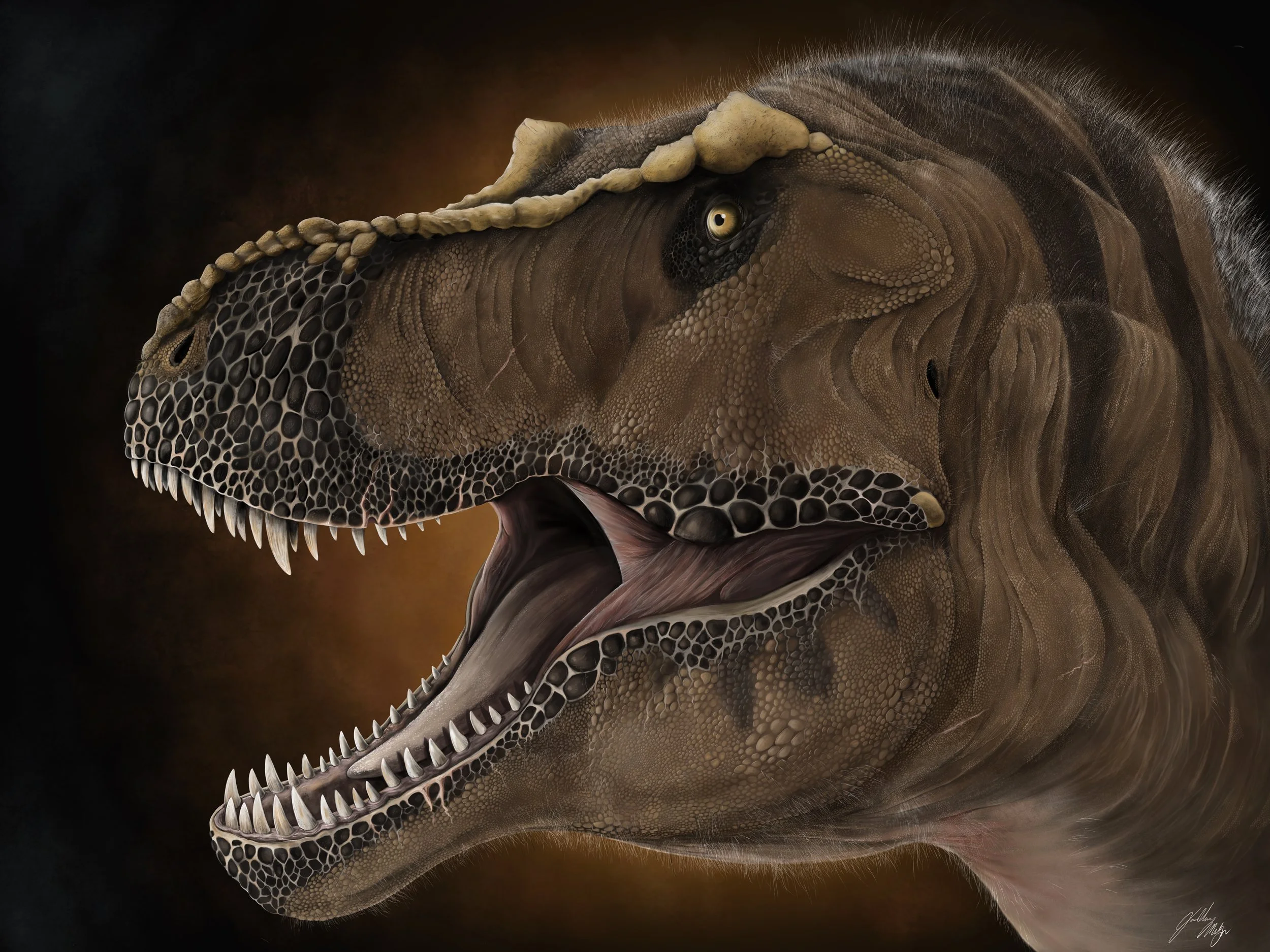
Adults could stretch up to 12.3 meters (40 feet) long and tip the scales at over 8,000 kilograms (nearly 9 tons) — roughly the weight of an African elephant, but with considerably worse table manners. Its skull alone could be over 1.5 meters (5 feet) long, and its bite force was the most powerful of any land animal we know of: scientists estimate around 57,000 newtons, which is enough to crush bone like a potato chip. Those tiny arms? Powerfully muscled. Scientists just can't agree on what they were for, which is somehow funnier.
On the menu: duck-billed hadrosaurs like Edmontosaurus and horned tanks like Triceratops. We know this not from eyewitnesses but from fossil poop (coprolites — yes, this is a real scientific term) and bite marks left directly in bone. Baby T. rex hatchlings, only about 1 meter (3 feet) long at birth, started life eating small mammals and lizards before graduating to full-scale dinosaur-size mayhem as they grew.
Its world was a warm, lush subtropical floodplain threaded with rivers — dense forests teeming with crocodilians, turtles, early flowering plants, and small, deeply unfortunate mammals. T. rex was the unquestioned apex predator, and everything else in that ecosystem had, over millions of years, developed a very healthy appreciation for that fact.
02
The Road to Birds
T. rex, with its three-clawed toes and beastly foot prints, belongs to Theropoda (literally meaning "beast foot"). This is the same evolutionary group that produced every living bird on Earth. The Dino Nugget (the most superior form of nugget, academically speaking) is, taxonomically speaking, a distant relative of this animal. Life imitates art.
The connections run surprisingly deep. T. rex and its relatives had hollow, air-filled bones — a feature every bird alive today still carries. Female specimens show evidence of medullary bone, the exact same calcium-rich tissue that only egg-laying birds produce (essentially the same biology behind your grocery store eggs, scaled up to something terrifying). Its inner ear structure closely mirrors that of modern birds. Close relatives like Dilong and Yutyrannus were outright feathered, confirming feathers were ancestral to the entire tyrannosaur family tree. And — here for posterity — T. rex had a wishbone. A furcula. The same forked collarbone you snap at Thanksgiving. Paleontologists confirmed this in 1992 and the holiday has never felt quite the same since.
Tyrannosaurids sit as a sister clade to Maniraptora — the direct ancestors of birds — meaning T. rex and the swans drying its wings at Lake Eola share a more recent common ancestor than either does with a crocodile. The crow eyeing your lunch from that nearby palm tree? Distant cousin. The Sand Hill Cranes that walk through our neighborhoods and parks every year? Also distant cousin. It's a lot to process. Take your time.
▶ Evolutionary Pathway
Dinosauria→
Theropoda→
Coelurosauria→
Tyrannosauridae→
Maniraptora→
Avialae→
Aves (Birds)
Tyrannosauridae is a sister clade to Maniraptora (the direct bird ancestors) within Coelurosauria. T. rex is not a direct bird ancestor but shares a very recent common ancestor with them — closer to a sparrow than to a crocodile.
03
Recent Research
2025
Nanotyrannus and Tyrannosaurus Coexisted at the Close of the Cretaceous
Zanno & Napoli — Nature (2025) DOI: 10.1038/s41586-025-09801-6
2026
Prolonged Growth and Extended Subadult Development in the Tyrannosaurus rex Species Complex
Woodward et al. — PeerJ 14: e20469 (2026)
2025
In Situ Analysis of Vascular Structures in a Fractured Tyrannosaurus rex Rib
Mitchell et al. — Scientific Reports Vol. 15, Art. 20327 (2025)
2025
Tyrannosaurus rex: An Endangered Species (fossil trade ethics)
Carr, T.D. — Palaeontologia Electronica 28(1):a16 (2025)